
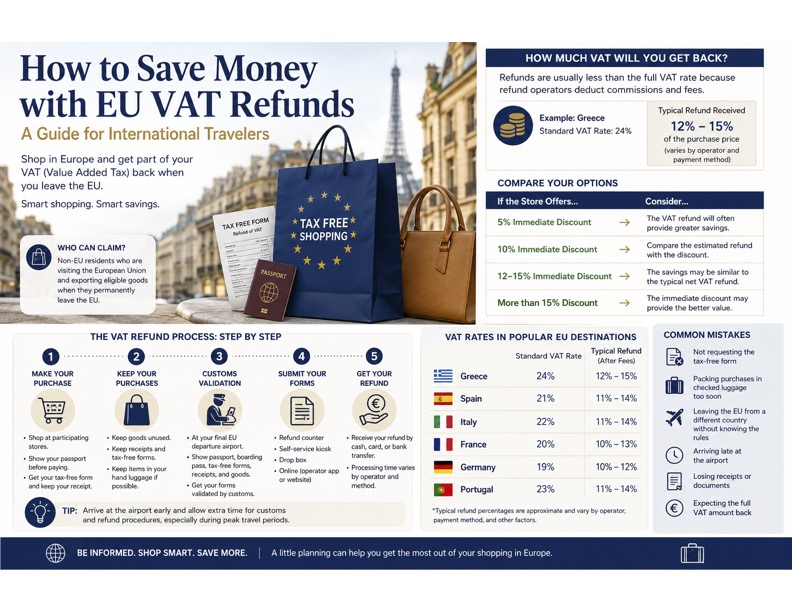
If you live outside the European Union and are planning a shopping trip to Europe, you may be eligible to recover part of the Value Added Tax (VAT) paid on qualifying purchases.
Many visitors are surprised to learn that they do not receive the full VAT amount back. While tax-free shopping can provide significant savings, the final refund is typically reduced by commissions and administrative fees charged by authorized refund operators.
Understanding how the system works—and comparing your options before making a purchase—can help you maximize your savings.
What Is a VAT Refund?
VAT (Value Added Tax) is a consumption tax included in the purchase price of most goods sold within the European Union.
Visitors who normally reside outside the European Union may qualify for a refund of part of the VAT paid on eligible goods that are exported from the EU in accordance with the applicable tax-free shopping rules.
Eligibility requirements, minimum purchase thresholds, and procedures vary by country.
How Does the VAT Refund Process Work?
Tax-free refunds are generally processed by authorized private refund operators rather than directly by the government.
The amount ultimately refunded depends on several factors, including:
- The purchase price.
- The applicable VAT rate.
- The refund operator processing your claim.
- The refund method selected (cash, credit card, or bank transfer).
- Applicable commissions, service charges, and administrative fees.
As a result, two purchases with the same VAT rate can produce different refund amounts.
Example: Shopping in Greece
If you are shopping in Greece as a visitor from outside the European Union, it is worth comparing your available options before completing your purchase.
Option 1: Claim a VAT Refund
Greece’s standard VAT rate is 24% on many goods.
Although VAT is included in the purchase price, travelers generally do not receive the entire VAT amount back.
After commissions and administrative fees are deducted, many travelers receive an effective refund of approximately 12% to 15% of the purchase price, although the exact amount varies depending on the refund operator and payment method.
Option 2: Accept an Immediate Store Discount
Some retailers may offer an immediate point-of-sale discount instead of preparing tax-free documentation.
Depending on the discount offered, this option may provide savings comparable to—or even greater than—the net VAT refund while eliminating paperwork and waiting for reimbursement.
Which Option Is Better?
As a general guideline:
| If the Store Offers… | Consider… |
|---|---|
| 5% Immediate Discount | The VAT refund will often provide greater savings. |
| 10% Immediate Discount | Compare the estimated refund with the discount. |
| 12–15% Immediate Discount | The savings may be similar to the typical net VAT refund. |
| More than 15% Immediate Discount | The immediate discount may provide the better overall value. |
For expensive purchases, ask the retailer to estimate your expected refund before completing the sale. Some merchants can provide an estimated refund amount through their payment system or on the tax-free documentation.
Why Doesn’t the Tax-Free Form Show the Exact Refund?
Many travelers expect the tax-free form to specify the exact refund amount.
Instead, the documentation usually lists the purchase information while the refund operator later calculates the amount payable according to its own fee schedule.
The final refund may also vary depending on:
- The payment method selected.
- Service charges.
- Administrative fees.
- Currency conversion, where applicable.
For purchases subject to Greece’s standard 24% VAT rate, travelers commonly receive approximately 12%–15% of the purchase price after deductions, although individual results vary.
What If the Merchant’s Estimate Doesn’t Match the Final Refund?
Occasionally, the refund estimate provided by the retailer differs from the amount ultimately paid by the refund operator.
This may occur because:
- The retailer provided only an estimate.
- The refund operator applies its own commission schedule.
- Additional processing or payment fees were deducted.
- The payment method affected the final calculation.
If a retailer advertises or specifically promises a particular refund amount, but the amount ultimately paid is substantially lower without explanation, you should request a detailed breakdown from both the retailer and the refund operator.
Greater transparency regarding commissions and fees benefits both consumers and retailers.
How to Claim Your VAT Refund
1. At the Store
Keep your receipt.
Confirm that the retailer participates in a tax-free shopping program.
Present your passport before paying.
Request the tax-free documentation.
2. Keep Your Purchases Accessible
Customs authorities may ask to inspect your purchases before validating your paperwork.
Whenever possible:
- Keep the goods unused.
- Keep receipts with the tax-free forms.
- Carry the goods in your hand luggage when practical.
If the items are packed in checked baggage, visit customs before checking your luggage.
3. Obtain Customs Validation
Before leaving the European Union, obtain customs validation at your final point of departure from the EU.
Customs officers may request:
- Your passport.
- Boarding pass.
- Tax-free forms.
- Purchase receipts.
- The purchased goods.
Without customs validation, refund operators generally cannot process your refund.
4. Receive Your Refund
After customs validation, submit your documents through one of the available methods:
- Airport refund counter.
- Self-service kiosk (where available).
- Secure document drop box.
- Online submission through the refund operator’s website or mobile application (where supported).
Refunds may be issued by:
- Cash.
- Credit or debit card.
- Bank transfer.
Final Thoughts
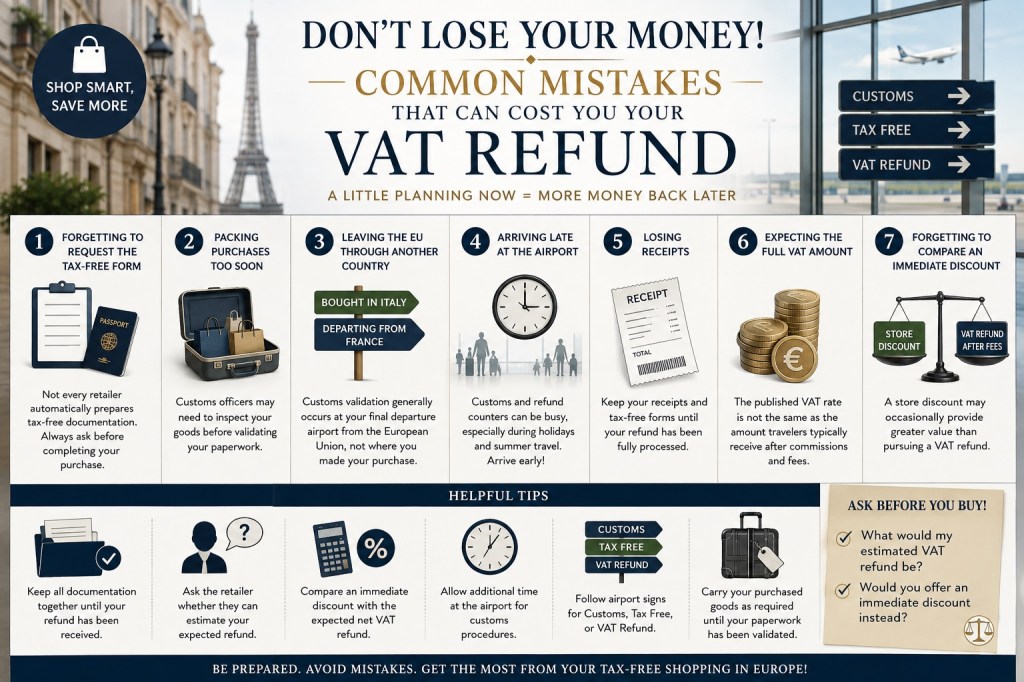
VAT refunds can provide meaningful savings for international travelers, but understanding the process is essential. The amount ultimately refunded is often significantly less than the country’s published VAT rate because commissions and administrative fees are deducted before payment.
Before making a significant purchase, compare the estimated VAT refund with any immediate discount offered by the retailer. In many cases, negotiating a point-of-sale discount may provide equal or greater savings while eliminating paperwork, airport procedures, and waiting for reimbursement.
A few simple questions before completing your purchase can help ensure you receive the greatest possible value from tax-free shopping in Europe.
Disclaimer
This article is provided for general informational purposes only and does not constitute legal, tax, or financial advice. VAT refund eligibility, minimum purchase thresholds, documentation requirements, refund amounts, and processing fees vary by country, retailer, and authorized refund operator. Travelers should verify current requirements with the retailer, the refund operator, and the customs authorities of the country from which they are departing the European Union before making purchases or submitting a VAT refund claim.



Deja una respuesta